|
|
| TumblingTIPS™ |

          |
|
 |
||
Layout Twisting |
||||
|
I am a power tumbler, and I'm at the point where I am working on twisting. I've been trying to twist on and off for over a year, and I still can't even do a consistent half. I should be able to...my layouts are hollow and about 8 feet off the ground and my tucks are really high too. Any tips for me? I round off right and twist left, and that's about as far as we've gotten on this. Thanks so much! I have access to a rod floor, panel mats, a not-very-squooshy crash mat, a couple of wedges that kinda sink, and we are getting a double mini-tramp at some point. We will be getting an overhead spotting thing when we get the double mini trampoline. ~Kassiane
As you'll see, twisting is NOT a little something we just toss onto skills. It's adding a NEW dimension to a skill that's already sophisticated and risky. The exercises Coach McCollum describes are intended to be performed in a well equipped GYMNASTICS environment with a qualified spotter. These are NOT easy concepts to grasp, and even tougher to perform well. Please feel free to write back to me with your questions. Now you can use your tablet to help build specific strength for superior tumbling, click to find out how. ~Coach Wayne!
"There are two main problems future twisters have: PROBLEM #1. Air awareness - trying to figure out where you are while upside down flipping and twisting. (a "multiple axis" flip.) PROBLEM #2. Not keeping the body lined up with the long axis as you execute the twist. The long axis runs through the center of the body from the head to the feet. It is the axis which the body spins around when you twist. If the head or shoulders or both get too far away from the axis you begin to encounter many problems. Also, you will have problems doing the skill the same way each time. Here are two exercises that can help you solve both problems, but it may require that you become very open-minded and think of skills in a different way: EXERCISE #1. STANDING TWIST - Did you crash and burn or did you land EXACTLY as you had started? (arms overhead, feet together, body tight and straight!) If your arms are going off to the side you were probably falling all over the place. Keep your arms in line with the long axis of the body as you twist. You may have to do 1/2 turns (twists) until you get this straightened out. EXERCISE #2. UPSIDE DOWN - That's right! We're going to do a back handspring in the air. Imagine the round-off entry VAULT you see competitive gymnasts perform on TV all the time. They do a round-off onto the board and a back handspring onto the vault, but what if the vault wasn't there? You would have a beautifully stretched layout just waiting to be twisted. Your arms are already up overhead to keep the body in alignment when you twist. You are stretched so as to slow the flip and give you more time to complete the twist (called float time) and your arms are reaching for the floor to give a reference to where you are in the air. You can know where the floor is at all times because you are always reaching for it. OK, now work with me a little longer. Here are the progressions: STEP #1: Back handspring in the air (or up onto a mat). When you do this drill you must KEEP YOUR ARMS pressed against YOUR EARS. This means your body is in the correct position to twist. You can do this on the trampoline. On the rod floor. Off the double mini. In the twisting belt. DESCRIPTION: Bounce on the tramp with arms on the ears. As you hit the bed of the tramp start reaching for the floor while keeping the abs tight and lifting the chest up. As you bounce up, pop the hips up to the ceiling as you continue to reach for the floor and tighten the body up into a straight line position. Finish by hollowing down and land with arms still on the ears. STEP #2: Back Handspring with a half twist.....The half twist is done on the last third of the skill. Also, it is very important that you "reach" backward as you finish the half twist. This would land you in a stretched arch stand (Not too much though; protect your back from injury.) This "reach back" is important so your arms are still in the position to do more twisting. If you were to pull your arms forward as you land, you would be pulling your arms and body out of alignment with the twist. DESCRIPTION: Bouncing on the tramp, start your bk handspring in the air as before making sure to reach for the ground first. Always see the ground before you ever begin the half twist. As your feet come down to execute a half twist (keeping arms on ears) making sure to reach backward for the floor as you land. Whatever spot you reach for when you start the skill is the same spot you should reach for as you twist. You can also do this drill on the tramp bed as a back handspring. You would land on your hands then do the half twist as you pushed off and landed on your feet. You can also do back handspring up onto a porta-pit or onto an 8 inch on top of a wedge. Push off and land on your back after you do the half twist. Be careful of landing on your stomach or sides At this point, it is a good time to try and twist in both directions to see which might work best for you. PROBLEM-SOLVING: Don't twist too early or you will get lost. Keep your hands reaching for the floor as you twist. Make sure you reach for the floor at the beginning. If you don't your layout will not be in the correct position to do the twist and your arms will be out of alignment. STEP #3: Add more twist. As you start the half twist, just continue to reach for the floor and twist the body around to complete a full twist. Try to reach for the same spot on the floor throughout the entire skill. Reach for the floor first before you twist. This gives you enough flip to work with...it puts you in the correct twist position and gets you oriented to the floor to help develop your air awareness. You can also do this skill on the tramp bed with hands down first then pushing off and doing a full twist before landing on your feet. DESCRIPTION: On tramp, as you bounce, reach for the floor first then start twisting while continuing to reach for the same spot. If you start by reaching for the center of the tramp then continue to reach for the center of the tramp as you twist. Now you can use your tablet to help build specific strength for superior tumbling, click to find out how. STEP #4: Keep working it until you can complete the full twist before you land. Once you have that down, start to try different arm position as you twist, such as bent arms or pulling your arms down to your side. If you start having problems then work your way back through the progressions. Sorry, this is so long but twisting isn't really a simple subject. Remember that it takes patience and consistent practice to master twisting." ~Jon McCollum As you can see, you've got to be a THINKER to be exceptional at twisting, whether it's on the mats in gymnastics, or on the football field. If your layout salto isn't strong enough to begin twisting it's a GREAT idea for EVERYONE to practice the first exercise above. A standing jump-full-turn, landing in balance, on your feet, is a LOT tougher than it seems. You really CAN'T do too many of them. I recommend that they be a part of EVERY practice! You may also be interested in the following:
|
 |
|||
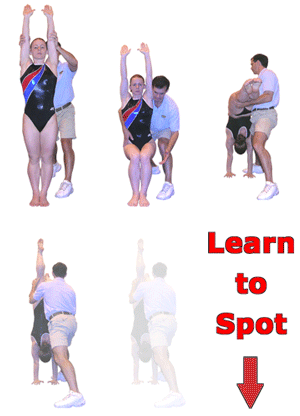 Learn to spot! Call NOW 912-238-1747
|
||||
|
|
||||
 |
||||
 Dear Coach Wayne,
 Kassiane sounds like she's an advanced tumbler, doesn't she? With a tight layout that's plenty-high in the air, she should be ready to begin her twisting. To help, I asked Coach Jon McCollum to offer some Tumbling Tips for twisting. Coach McCollum is a brilliant tumbler & veteran instructor in Ft. Smith, Arkansas. He's famous for his technical accuracy in skill execution. He has offered us some marvelous exercises in response to Kassianne's question.